
All Change Happens at the Margin; A Great Company CAN be a great Investment (Research)

US Bonds: The Trend is your friend until it isn’t….

“As all of us were taught, but most of us have long since forgotten, economic change occurs at the margin, where the action takes place… individuals who can think on the margin always have an advantage over those who cannot.”–Arthur Zeikel

Are Great Companies Great Investments?

I can’t emphasize enough how much these lectures–linked below–helped me improve as an investor. You will be further along your successful investment journey by absorbing these lessons.

As one great investor who lectured at Columbia GBS: R_Bruce_EMBA_Feb_29_2008 and Complete R Bruce said, “I have evolved to buying stable companies with long histories of strong profitability, cash flows, balance sheets and judicious use of capital allocation.”

More research confirms the efficacy of that strategy. Boring works. Great Companies Great Investment and GMO_WP_-_2012_06_-_Profits_for_the_Long_Run_-_Affirming_Quality

Housing Update

We first mentioned housing stocks here http://wp.me/p1PgpH-2g on September 21, 2011–almost exact day of the price bottom and the day of the Wall Street Journal article pointing out the ever worsening housing statistics.
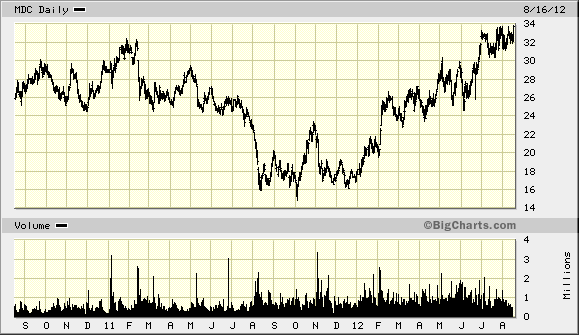

Now the news is getting better, but the prices have already doubled from the lows.  A lesson here.

10 Responses to All Change Happens at the Margin; A Great Company CAN be a great Investment (Research)

  1. John,

    What happens to the housing recovery if interest rates start rising?

    And how high can the housing market go? Are millions of Americans suddenly more credit worthy after waves of foreclosure, default, job loss, etc?

    It’s always about the risk vs. reward.

  2. Looks like robert bruce was buying NOK. Net income has turned negative, I wonder if he still owns it?

    • No, he would have owned it, but he would have sold it. The franchise is gone. A risk you take so you diversify with this strategy 20 to 30 names.

      I would love to lose on NOK, while making money on NVS, MMM, IBM, etc.

    • Actually, NOK is a very very interesting example. If memory serves, he bought it some time in 2007 and sold later that year, realising a profit.

      But in reality, I think it’s fair to say that he was “wrong” – in my humble opinion. Despite a long run of above-average returns on equity, NOK was about to decline thereafter. His timing was lucky. Any different, though, and he’d be nursing heavy losses. Sometimes you can be right for the wrong reasons. That was one of those times. I just had a quick look at Google Finance, and I see straight away that NOK has been on negative earnings for at least the last 5 quarters. Whatever qualities it has, it’s gone. Seems like a dangerous value trap now, where investors are hoping for a recovery that may never come.

      It’s also interesting to look at the company in terms of “the story”. I think he liked long-run historic performance, and mistrusted “stories” as short-termist noise … unlike Peter Lynch, who emphasised following the story, and investing appropriately. In my mind, NOK exemplifies why Peter Lynch is right, and Robert Bruce is wrong.

      • mcturra2000, I have to disagree a bit with your regarding Peter Lynch. A big determinant of his success was due to massive bull market during his time. I am fairly convinced that he would NOT perform anywhere close to what he did if he was still investing these days based on stories (though I’m convinced, it’s obviously impossible to test that assertion)

        I believe 90% of wall street is currently “Right time, Right Place” and I see it all around me. All the major founders of big hedge funds these days Steve Cohen, Ken Griffin, etc etc etc all benefited from this. Their success cannot be emulated today and are recipients of LUCK more then anything. Michael Lewis commencement speech at Princeton touched on this topic well. Even Robert Bruce, it says he went to CBS in 1970. I REALLY AM CURIOUS HOW DIFFICULT IT WAS TO BE ACCEPTED INTO CBS or HBS in 1975 then in 2012!!!!!!!!!!!!!!! I attended a top university and I am fairly sure that I would not be accepted at this school if I was applying today!

        That is what draws me into value investing, special situation trading as these individual seem to be successful in the long run due to a real skill as opposed to opportune timing.

        • NN, I take your point on Peter Lynch being in the right place at the right time. He was positioned at a time where that was great for investing, and growth investing in particular. So yes, one can have a run lasting over a decade, and maybe approaching 2, only for it all to go horribly wrong thereafter. Just ask Bill Miller.

          Some of his stock picks look really bad years out, and much of it would be classified as junk. In fact, I think much of it has long since passed away. Clearly, what Peter thought was a good investment is totally different from what Warren Buffett would think of as a good investment.

          So I understand your argument. And yet, and yet … I think Peter deserves more credit than that. Peter invested in all kinds of situations, including turnarounds and value investing. In one of his books, he talked about how to think about the relative attractiveness of value versus growth stocks. Peter seems to have a very pliable mind and approach more so than any other guru. He seems to “understand” companies as dynamically evolving entities, whereas I think most other investors are inflexible in their style. He compares investing as an infinite game of poker. Each card that is turned up is either more or less favourable to your position, and must be responded to accordingly. There’s a great deal of right-brain thinking to it.

          Warren Buffett’s strength is that he’s just trying to clear one-foot hurdles, and he knows it. Peter Lynch seems much more adaptable and nuanced in his approach.

          The name Prem Watsa crossed my path recently (remember, I’m a UK investor so tend not to follow the US gurus too much), and took a look at his recent holdings. RIMM features often on the positions that he has added to. He added earlier this year, for example. Look at the carnage to his positions. Those investments look like schoolboy errors to me. Maybe I’m wrong, of course, and who am I to judge a fund manager who has much greater experience than me? Still, RIMM does look like a classic value trap.

          If I were to consider things from a Buffett and Lynch viewpoint, I’d say that Buffett would never enter into RIMM. Lynch, OTOH, would probably have exited any position he had long ago.

          Whilst we’re on the subject of Prem, I notice that he has a position in JNJ. It appears to be severely lagging the S&P 500. I’ve also seen that Buffett reduced his holding in JNJ earlier this year. I suspect that he sees defensives as a crowded trade, as one commentator put it. I think his position in Tesco looks like a good one, though (although I would, as I bought at around the same time as him). He’s a wily old bird, is Buffett.

      • Well, I think he lost money on NOKIA. He was betting on a reversion to the mean of high ROA, but he was wrong. You must accept into the (your) strategy that you will be wrong. Most battleships don’t sink but some in tough waters (technology) go down.

        You have to be careful of hinsight bias in analyzing mistakes. I bought Nokia and lost too, but I am happy to accept being wrong if that is the price to stick to my method.

        You are right that he looks at the numbers and not the story.

  3. As always, John, and excellent article. Papers written by GMO are always worth reading – and even top Howard marks in terms of their informativeness.

  4. I’ll bet Sam Stone from “Ruthless People” would say: Nokia is dead !

Leave a Reply