
Pzena (PZN) Disappointment, Despair and Tax Loss Selling

A reader has asked about search strategies and I plan to do a more indepth post on search strategies including screening techniques.

Some people think of what Thanksgiving may bring while I look for tax loss selling in small, obscure, and deeply disappointing stocks.

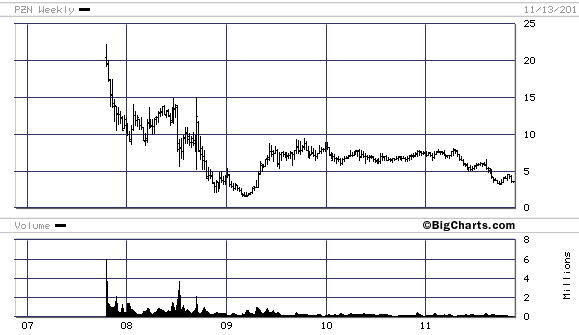
Here is one company that might fit the bill:
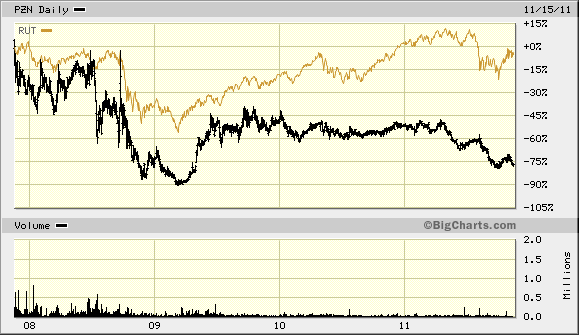
To understand the depth of the disappointment we might compare PZN to other small caps:
I have had enough

When I go to www.pzena.com and look at their recent press release I see $13.7 million in managed assets so a low-end valuation of assets under management (AUM) might be 2% or (2% of 13.7 billion or $274 million divided by 65 million shares (both A & B) or $4.23. Enterprise value is about $200 million after subtracting $38 million in cash and EBITDA is around $45 million (there isn’t much capex with human capital). If assets stabilize, then perhaps asset values are above enterprise value–I might have a margin of safety.

Mr. Pzena almost blew up his firm with investments in Citigroup (“C”) during the 2008/2009 crisis. His firm’s equity performance since then has been good but he has to maintain good performance to turn his three and five-year performance record to top quintile performance. Go here: www.pzena.com

Ok, so that is a reason I would then go to the 10-K and dig deeper; there is enough here to make it worth my time to spend another hour or two. Please, this is NOT an investment recommendation since there may not be enough of a cushion to have a comfortable margin of safety. Also, there may be more attractive alternative investments than this one.

The main point is to look for disappointment. Now I have no proof that there is tax loss selling but with the company underperforming the Russell 2000 for several years and the recent decline during this tax loss window (Oct. – Dec.), I am making a supposition that some investors are making a tax decision rather than an investment decision.

Let’s revisit this in 6 months to see whether my thesis has more substance.

18 Responses to Pzena (PZN) Disappointment, Despair and Tax Loss Selling

  1. I have been looking at an asset manager or two.

    The one i spent some time on recently is Janus Capital (JNS). It has $140 Billion in AUM and its EV is only $1.2 B. So thats less than 1% of EV to AUM.

    EV/EBITDA is 3.25.

    The biggest issue is constant outflows from their funds..but despite all thats its profitable, produces good cash flows….

    Let me know what you think

    • All asset managers in equities have been struggling to hold assets as investors shrink from risk and poor equity returns over the past 10 to 11 years. Pzena’s struggles are not just firm specific.

      Janus is loved by a value investor, John Ariel. Though it is cheaper than PZN, I have more confidence that Pzena will maintain and grow assets because his investment process is clear and it has worked (despite a major flaw pointed out in the next post). He avoids overpaying for most stocks while JNS pursues more of a growth approach.

      These companies have more risk so you need to be well-compensated for that uncertainty.

  2. It’s interesting for me to see how you value asset managers, because I’ve never had a crack at them.

    It’s interesting what adib said about “constant outflows”. I came across an article by Anthony Hilton in “This Is London” in early 2011, who penned this: “It does not matter how long these [asset management] businesses have been around nor how robust they appear to be on the surface. The fact is that they are built on confidence which in turn is rooted in the quality of the people they employ and the performance they can deliver. Any dent to that confidence means they are in trouble. They are arguably far too fragile to be listed public companies, though several of them obviously are.”
    http://bit.ly/evoJhA

    I hope you find it interesting.

  3. Yes, I agree that asset flows are based on confidence (and rear-view thinking since the best time to invest is AFTER bad performance provided the money manager sticks to a strategy that works–the manager systematically avoids overpaying).

    Pzena does, I believe, have a successful strategy of buying cheaply despite his crisis in financial stocks in 2007/2009. He has a major flaw in his strategy in regards to financial stocks (as does Bill Miller and many other “smart” money managers). I address this in the next post.

    Perhaps this is not the greatest example for valuation. I was trying to show despair and disappointment with tax loss selling.

  4. My dilemma off late has been balancing two approaches
    (1) buy the best business possible that has stable and predictable profits for a reasonable to cheap price ( Say Pepsi )
    (2) Buy a ‘decent’ business with problems (short term or over a few years) but that still is quite profitable, has good margins and cash flows and is also trading quite cheap (say 8 to 10x Earnings or FCF) or sometimes even cheaper as in the case of JNS.

    I think a decent business should be an attractive purchase candidate at some price (a bit lower valuation than the excellent company). Deciding how cheap I want this 2nd group of companies is what I wonder. I have failed to pull the trigger due to this.

    • Dear Adib:

      You might need to think hard about these different investment strategies.

      I think simply franchises vs. non-franchises. A stable franchise like Coke, WD-40, Kimberly Clark, General Foods will RARELY trade much below 20% to 30% below intrinsic values. Sometimes in a major 20-year meltdown like 1974, 1987, 2008/09 you get 40% to 50% declines like MMM or MLR. But if you can buy Coke at a 20% discount with 5% to 7% growth then over two-to-three years with the accretion of the discount plus growth you can get a 13% to 15% return over two to three years–certainly better than most professional investors. I guarantee you will outperform bear markets as well (look at the relative performance of “stalwarts” compared to an index excepting the Nifty Fifty period or 1998). You will underperform coming out of a credit crisis (early 2009 and 2010). The key is to buy and sell PRECISELY since price moves so little from intrinsic value. And why should it? The market does recognize usually that Coke is a better business than US Steel.

      With a JNS (I don’t know if it is cheap or not) but the discount and premium will be 50% discount to 100% premium since small caps can be vastly over and undervalued. But growth is typically not profitable or risk adjusted permanent loss may be higher. You need a higher discount to the asset (reproduction) value of the business.

      Also, keep careful record (in a notebook) of what you do and do not do at the time so you don’t fool yourself with hindsight bias. I “woulda, coulda, shoulda” is useless for improving your future performance. Say you will only buy JNS at a 50% discount to the low end of your intrinsic value (say $5) but it trades to $5.79 then goes to $15. You didn’t make a mistake by not buying because you stuck to your plan. Perhaps your discount rate was too high or maybe there were better alternative investments. There are rarely cut and dried answers. But few people EVER analyze their investments 1 month, 1 year or 10 years later.

      Good luck

      • John, I completely agree.

        I know of a UK investor who almost exclusively buys quality large-cap stocks, and has a reasonably low turnover. He says that he believes he has had about a 10% pa capital return over the last decade – a performance that more than comfortably outstrips the indices. He says that deeper value investing is all very well and good, but the inherent riskiness of them means that it’s very difficult to make them pay off.

        I once quipped on a bulletin board that I thought half the secret to investment success is “choosing the right beta”; meaning of going into much lower quality stocks during times of high volatility and depressed prices, and shifting to high quality stocks during low volatility and stable periods.

        I think the most dangerous times to buy low-quality value stocks I think are when they start to emerge out of the general market. They stand a high probablity of being slaughtered. Alas, Mr. Market is often not as stupid as he seems.

        • The key is in understanding the strengths and weaknesses of your strategy. Don’t enter a mule in the Kentuckey Derby; don’t have a thorough-bred pull a plough. Buying Novartis and expecting to buy it at a 50% discount is unrealistic but bought at a discount with profitable growth thrown in, you can do well plus sleep well at night. However, I do think you need to be somewhat diversified since you are playing the odds of mean reversion and you will never have an endge in knowing a Nokia, Novartis, Coke because they are too big and complex. Know they limitations.

  5. Good points John.

    On that hypothetical JNS example, say I want to buy at $5 so that i get a good upside for the additional riskiness. it may get to $5.25 and then go up. So, i think it makes sense to decide on your allocation to that company at an ideal price and then at slightly higher prices you can still initiate the position but at a much lower % invested in it (say 2-3% instead of a 5% regular position). Building positions by scaling in and reducing by scaling out is what I am trying to develop. Any thoughts on this? I think we can have a series of posts on Portfolio Construction and management, sizing etc… It would be good to see other approaches.

  6. Re: analysing investments …

    I wonder if people tend to draw the wrong lesson, though.

    In order to spare embarrassment, I wont mention any names, I know of soemtone who has a diversified portfolio of around value shares. The portfolio has performed broadly in line with the indices, with 1-2% pa outperformance. One of his investments had gone up a lot, which he said was obvious in hindsight given it was so cheap.

    But what was so obvious? If it was so obvious, then why didn’t he just buy the “obvious” ones, and avoid the non-obvious ones? And therein lies the rub of it. If you /really/ know what’s going to happen, then it makes no sense to “diworseify”. It’s very easy to be clever after the fact, but the crystal ball tends to be rather murky going in. I don’t necessarily think it even works for high conviction stocks.

    I’ve been reading over a few old Motley Fool articles, and it brings home the point that the future is very opaque. Sometimes, one is just wrong on the business fullstop, other times the businesses just changes, or that there are factors in play that would be very difficult to have known about. An example of the last category might be the BP disaster last year. Now, I have a little theory that someone, somewhere, probably an engineer, had known for some time that BP was playing too fast and loose with their quality control, and that there were disasters waiting to happen. It would have been difficult for an outsider to have known about it, and assessed the risks as an investment. Very very difficult to sort the signal out from the noise.

    Recently I saw an advert for Fidelity on Youtube. They were explaining about how their analysts did in-depth research into companies like BLT (BHP Billiton). I was thinking to myself that this is all well and good, but where does it /really/ get you? BLT is a mining company. You dig the dirt, throw away the dirt, and sell the remaining good stuff. Trying to estimate future profits seems like an exercise in futlity. Profit = Price X volume – costs. The problem is, “price” is the very thing you don’t know. With commodities, anything can happen. BLT’s future profit is a completely open question. Nobody knows. So then, presumably, you’re down to questions of macroeconomics, and microeconomics. Will China demand remain strong throughout the next decade, and will profits be competed away as miners search for deposits in increasingly expensive areas?

    We’ve got two problems! Firstly, of the problems we know about, it’s difficult to attach probabilities to the outcomes, and hence determine if something represents good value. Secondly, there’s the stuff we don’t know about – which, of course, we can’t even hazard a guess.

    I think value shares are amongst the most problematical of the lot.

    Ah, if only it were easy.

  7. John, I am interested in understanding why you chose the 2% number. I’m not familiar with asset managers, are they usually valued as a % of AUM?
    Thanks.

    • Hey Logan thanks for the intelligent question. If you read through different asset managers 10-Ks and Web-sites and compare their assets under management to their share prices (enterprise values) then you see a range of 2% to 5% of assets under management (AUM). The percentage on AUM is a function of the future cash flows which depends on the type of assets (stocks pay higher fees than fixed income) type of client, track record, ability to retain and grow assets, etc.

      I took the lowest end of the range. Now Pzena has some union pension assets which I would rank as lower quality but he also has individual accounts and other institutional accounts that should be stable so I took the 2% number as conservative. Note the valuation of Pzena when the company came public–about 3% to 4% of AUM. I don’t think Richard Pzena is the second coming of Buffett but he isn’t the worst either. He has a disciplined value approach. If he maintains his improving record then his assets will grow but I am not investing because of that–only that his assets will not decline. Since it is an asset type investment and not a franchise–it is a smaller position for me.

      Here is one mention of EV to AUM:
      http://www.valueinvestorsclub.com/value2/Idea/ViewIdea/10589
      Valuation
      First, there’s the multiple of EV/AUM. Traditional equity asset managers tend to trade between 2-5% of EV/AUM, you’ll see this is the case with a comp list of : WDR, PZN, JNS, AMG, TROW, BEN, CLMS, GROW, EV. But when you look at firm structure and asset class weights, again, Virtus looks a lot more like Legg Mason. Legg trades at .7% EV/AUM, which is about the lowest it’s been in years. It’s traded as high as 2.5%, and should probably trade around 1% EV/AUM. Anyway, Virtus trades at a measly .4% EV/AUM. This is nothing for an asset manager, even bond managers like Federated. I don’t care if Virtus’ margins do lag the industry right now, that’s a fixable problem. This multiple of AUM, for a traditional manager, is silly. Legg, despite being an essentially distressed firm nearly left for dead, is still managing to trade at almost 2x the valuation of Virtus. Plus, Virtus has the value of the NOL’s, which are worth about $40m.

  8. Hi, in this book written by Martin J. Whitman ‘Value Investing: A Balanced Approach’ he says that for financial institutions like broker/dealers and other money managers you should buy when the price is lower than tangible book value plus 2% to 3% of assets under management.
    So, these are my numbers (aum@end of Sept):
    Tr.Ytd(%) Name Aum (bln)EV/AUM P/FV
    -7.2 CALAMOS ASSET-A $31.80 1.5% 31.0%
    -26.4 LEGG MASON INC $612.00 0.7% 29.0%
    -57 ARTIO GLOBAL INV $34.30 1.0% 46.0%
    -29.2 SEI INVESTMENTS $151.40 1.7% 79.0%
    -17.9 EATON VANCE CORP $177.80 1.9% 75.0%
    -34.6 PZN
    Of this group I have a position in LM, in my opinion an undervalued turnaround story and the P/Fair Value number tell me that now the market is pricing around @ 1/3 based on Whitman’s approach.
    What I find difficult to understand in PZN is their shareholder structure (and maybe CLMS is very similar): if you go to the last 10k http://phx.corporate-ir.net/External.File?item=UGFyZW50SUQ9ODU3MjJ8Q2hpbGRJRD0tMXxUeXBlPTM=&t=1 and see their holding company structure and ownership as of December 31, 2010 (P. 6-7) … they mention that “Class B Shares have the right to receive 85.5% of the distributions made by Pzena Investment Management” (and these shares, ehm, are held by Principals) … so I don’t know if at the end of the day earnings are going to the public shareholders.

    • Thanks Giuseppe for a thoughtful, analytical post:

      For full disclosure I own LM as well (more than PZN). I am not concerned with the shareholder structure of PZN because I “know” Richard Pzena. He went public as a way to build a business that would outlive him with a structure to tie his staff and money managers to the company with share ownership. If he screws 15% of his minority shareholders (Public shareholders) then he would damage the value of the 85% remaining shares–like peeing in your own drinking water.

      Money managers are out of favor. The bad news is that value declines as assets decline which you can’t predict with certainty, but the business has tremendous leverage on the upside if assets rise or come in the door. I spread my bets and I try to buy at a discount to NAV or (2% of AUM).

      I hope you do well with LM. Just don’t expect the glory days to return.

      Regards,
      John Chew

  9. Hi John, thank you for your answer. Another way to look at LM is to sum up the parts: I hadn’t enough time to do the homework but my feeling is that if you consider Western like Federated and Royce like Gamco or Artio, my impression is that you are left with Permal and Clearbridge valued in the neighborhood of nothing … Don’t you think LM and JNS should merge themselves and exploit what in my opinion could be tangible economies of scale? Sorry for this digression …

  10. There are definitely economies of scale with money managers–the problem is merging the cultures and people. I don’t think JNS and LM would fit easily, but I don’t really know JNS and LM in great depth.

Leave a Reply