
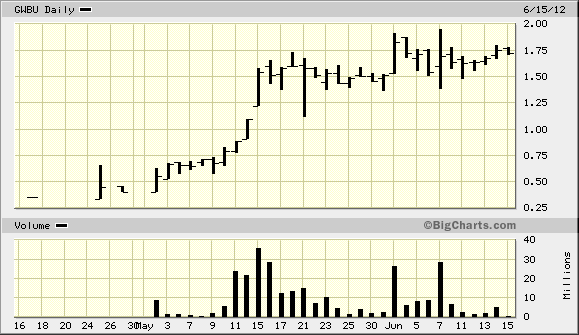
GWBU (Part of the Death Portfolio) Can’t Be Shorted

I first discussed the horror here:http://wp.me/p1PgpH-Py.  I call GWBU a “death stock” because this is a big $0.00. The problem is the shares are tightly controlled. After two weeks of scouring various brokerage firms, I could not find any shares to borrow.  I must find other prey.  But at least these pump and dumps offer perfect case studies of what to avoid.
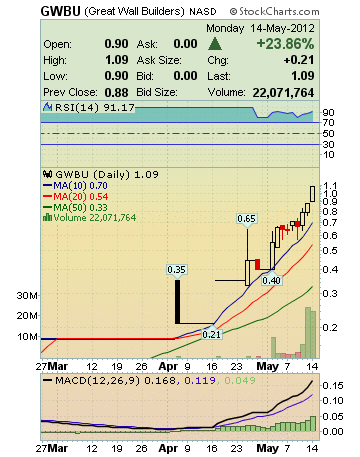
Below is a link to an article discussing the pump and dump in more detail. Despite 300 million shares outstanding, not a share to borrow. Here is as manipulated a market as you can find. This is a $0 within two years like our other study, SNPK.

The collapse in price will be violent.

http://www.aimhighprofits.com/what-makes-great-wall-builders-gwbu-stock-so-great

A visit to GWBU’s headquarters showed a disturbing scene: http://www.youtube.com/watch?v=TRDpTEjumdo

Have a good weekend.

7 Responses to GWBU (Part of the Death Portfolio) Can’t Be Shorted

  1. Perhaps you could team up with a market maker or someone with a short sale exception. I\’m aware of one high level trader at a boutique equities firm that simply shorts the hell out of pink sheet/OTC stocks going parabolic, takes tons of pain, then covers near 0 and makes a few 100k. Not a bad gig, and he goes 0 work on names, imagine if he really knew what he was doing!

  2. Your posts take up a ton of my time and so I have mixed feelings. I both enjoy that you post good content, but sometimes I get angry because there is no stopping to it. Overall, thanks.

    Now, this post and your previous one that linked to Abe Briloff’s story took up quite a few hours. Ultimately, it led me to reading about a few different companies.

    1) http://faculty.msb.edu/homak/homahelpsite/webhelp/15__Delusion_Fortune_2-5-01.htm – Home Depot is mentioned here for just having really silly projections of EPS growth of 23-25%, which I found interesting because they were at the top of the list of companies with greatest growth in the last 30 (?) years.

    2) Gillette is there too.

    Gillette was engaged in channel stuffing in order to meet goals. They stopped it, and they stopped meeting goals, and the stock price plummeted. Buffett has been quoted telling a similar story about Gillette (I couldn’t find a link), but it looks like he invested in it despite that issue.

    3) Long Leaf Partners (Southeastern Asset Managment) held a stake in Waste Management, and they bought into it before the accounting troubles were verified. Abe Briloff had written about them prior to it. They also own a ton of Chesapeake, which has been one of the most discussed shorts/longs on the VIC. Surely they had some clue something that was off with disclosures like the one where Aubrey sold $50M of artwork to the company for use in the main lobby. That just doesn’t slide by your desk.

    Here’s the difference I see in people who have made billions and maybe the reporters (no offense, because it’s very valuable) who also uncovered likely the same information. The reporters are going to end up being hated by many people. How many people absolutely *hate* Buffett because he spoke negatively about them? There seems like there is a natural cap on the ability to make money simply by taking short positions (in any form, like derivatives, and so on), because you simply can’t allocate the $170 Billion of book value that Buffett has to short positions. He has a tough enough time being able to buy good long positions.

    Now… my point for writing is to ask a question, sorry it took so long to ask. Sometimes, I believe a company has a “potential intrinsic value” and “realizable intrinsic value.” Let’s say that Gillette’s cash flow production from selling razors in a market that isn’t drastically changing is about $2 Billion/year. Purchasing that is like buying a bond that pays $2B/year in interest, it’s easy to determine the “potential intrinsic value.” Let’s say that management is poor at allocating capital though and ends up wasting $100M every year on things that shouldn’t be purchased, like extra Gulfstreams or something. Now, the realizable intrinsic value is $1.9B/year.

    So for a net-net, the “potential intrinsic value” is all the cash less liabilities and expenses with shutting it down. The “realizable intrinsic value” is _far_ less, because most are in the current situation because management hasn’t allocated capital well and it doesn’t appear to be a situation where they will change and distribute capital. (Please write to me if you find out how to change their behavior) In reality, many seem to just wind up as a big 0 given time, or they use the overvalued stock relative to “potential intrinsic value” to buy companies.

    The question: Do people like Buffett and funds like South Eastern sometimes buy the stock of a company knowing these problems in advance? Is it still wise to do so for us as investors, specifically as passive minority outsiders? It seems like many great companies run into these issues and so I’m not sure that we are just going to find companies where everything is okay and without a spot of trouble. With enough digging, there are always bound to be issues that we will find. Even Buffett, in his dealings with AIG through GenRe, doesn’t appear to be 100% clean. The accusation is that AIG was purchasing “reinsurance” on losses, but only *after* the losses. The cost was lower than the loss, but these loss transfers occur because if you can guarantee the renewal of the contract that that pricing well into the future on less risky contracts, it essentially becomes a loan and a way of hiding the losses from the income statement and balance sheets. It’s just a loan under the guise of reinsurance in that case. Well, do a search for “Buffett” here and read about it: http://scas.issproxy.com/pdf/29060cmp.pdf

    I’m having trouble finding the link where it’s described from another transcript, but it said that Buffett was on calls with the GenRe folks every day during this time period of the AIG deal going through. This is where my complete tinfoil hat comes on, because how could Buffett not realize what was going on? This was such a big deal and with a company in extreme times and people ultimately went to jail.

    I guess that when you’ve got a big enough company, Buffett is right – odds are, that somewhere, someone is doing something incorrectly. I guess our focus should be on an “intrinsic value” because those other things are outside of our control, but it does make me often wonder if buying a great company with questionable management is okay. It could be a really beautiful “potential intrinsic value” but a poor “realizable intrinsic value” and I don’t yet know how I feel I about those situations. I’m just not finding companies where everything is laid out in a very clear manner.

    To readers: Please excuse the length of this “comment” and the fact that it hasn’t been proof-read entirely.

    • I should add… Einhorn was once looking at AOL as a short due to accounting, but took a long position despite that because of the economics of the business. I’m guessing that he had to overcome this hurdle at some point, because there were accounting issues, but he still bought it.

    • Well Buffett has always sided with the underlying quality fo teh business vs. management.

      There are investments where the quality of the capital allocators is high (loews, Seacor) but the businesses are basically assets (oil rigs, hotels, tug boats). The best is a combination, of course.

      If the management is bad enough, depending on the structure of ownership, that can be a proxy war.

      There are many ways to hell or heaven, you need to choose what YOU feel comfortable in doing.

      After a while, you will naturally gravitate to what interests you or where you have success if you are honest in your self-appraisal.

  3. Directly regarding GWBU… aren’t shorts in companies like this dangerous? Klarman, in Margin of Safety, describes that one of his chief concerns is that if an overvalued company uses its stock to make acquisitions, it can actually increase the intrinsic value of the company. LeasCo is often cited for having ridiculous accounting, and it did, but it used the overvalued stock to buy an insurer with very sound assets and increased (at least temporarily) the intrinsic value of the company. I guess that we can only put the odds in our favor though, and so they might not always work out 100% perfectly, but the odds are in our favor. Do we just hope that no one agrees to be bought by guys like this, and so paying with overvalued stock maybe just works better for the Singleton’s of the world who actually understand business, rather than someone pumping a penny stock, who would be laughed at by potential seller with just 5 minutes of research?

    That, and maybe we can utilize call options to limit the downside in a short against the stock price moving up.

  4. this should be reported – send referrals like this to associationofcorpwhistleblowers.com!

Leave a Reply